



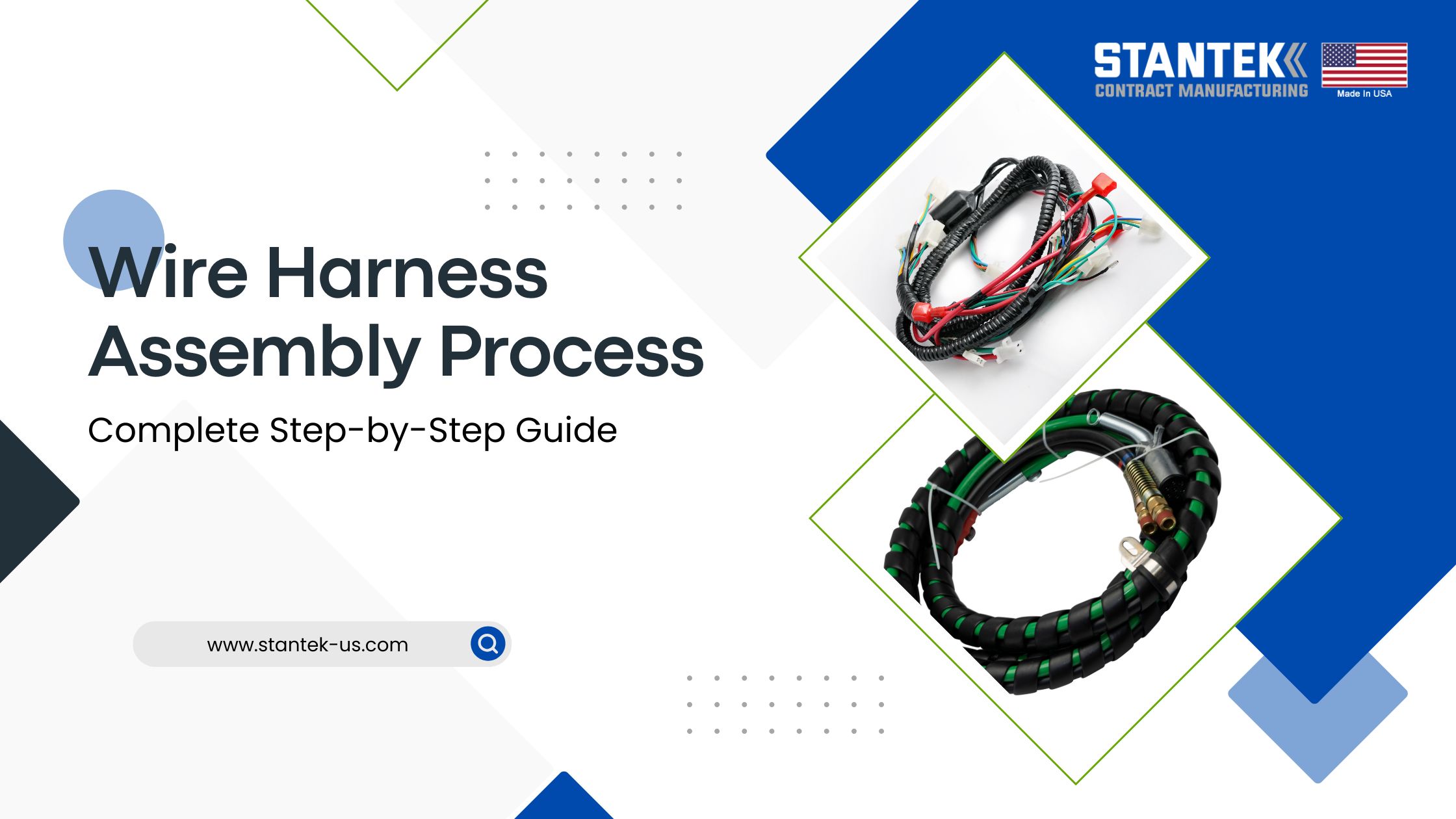
Electrical system failures are often linked to poor interconnect assembly rather than the equipment itself. A single routing error, weak crimp, or missed inspection point can lead to downtime, signal loss, or premature failure. For electrical engineers and equipment manufacturers, this risk is hard to ignore. Therefore, wire harnesses are used to group cables into a single manageable unit, helping organize cables, protect conductors, and route power and signals efficiently. However, a controlled wire harness assembly process is crucial to achieve safety and efficiency as every stage, from wire preparation through testing, affects safety, durability, and long-term performance. This post walks you through the complete wire harness assembly process step by step. It explains how the cable harness assembly process is built around quality control, and how each stage in the wire harness production process supports reliable performance in demanding operating environments.
What is a Wire Harness Assembly
A wire harness is a structured assembly of wires, connectors, terminals, and protective coverings that transmit electrical signals or power between components. This assembly helps organize individual wires efficiently. Instead of separate conductors routed independently through a system, a harness groups them into a single, manageable unit. A wire harness offers several benefits, including reduced installation and troubleshooting time. It can also help reduce the risk of damaged insulation or loose connections, which is particularly important in industrial applications where downtime can be costly, and failures may pose safety risks.
Process overview of the Wire Harness Assembly : Step-by-Step Breakdown
Here’s the stepwise wire harness assembly process:
- Step 1: Design and engineering review: detailed review of drawings and technical specifications along with project timelines and estimated volumes.
- Step 2: Wire Preparation (Cutting and Stripping): The wire preparation stage requires precision, as even small length errors can affect routing inside equipment. Hence wires are cut using automated machines to match exact length requirements. Before connections are made, each conductor is cut to the correct length and stripped of its insulation at the termination points. After cutting and stripping, wires are sorted and labeled. This helps trace each wire through the production line. It also reduces confusion during assembly, especially in large batch production
- Step 3: Crimping and Terminal Connection: Crimping involves mechanically deforming a terminal around a stripped wire end to create a secure electrical connection. It is one of the most critical operations in the entire wire harness process. A properly crimped connection is gas-tight, low-resistance, and mechanically strong. Every crimp batch is subject to pull-force testing. A properly crimped terminal should also withstand the mechanical stress of real-world installation and operation. Both automated and manual inspections are performed, depending on the requirements, to check for barrel deformation, wire strand inclusion, and alignment issues.
- Step 4: Connector Insertion and Sub-Assembly: Once terminals are applied, wires are inserted into connector housings. This step defines the electrical interface between the harness and the system it connects to. This step requires accuracy and consistency. Each terminal must be seated in the correct cavity of the connector housing, oriented correctly, and fully locked in place to ensure continuous electrical contact. In complex systems, sub-assemblies are created first. These smaller units are later combined into the final harness. This approach makes it feasible to produce large, intricate harnesses without exponentially increasing error rates. Connectors allow modular installation. This is especially useful in equipment maintenance where quick replacement is required. To ensure accuracy and prevent incorrect insertion, wire harness processes use built-in error-proofing methods such as Poka-yoke techniques. Color-coded wires, keyed connectors, and assembly jigs contribute to reducing errors.
- Step 5: Wire Routing and Harness Assembly: This is where the individual wires and sub-assemblies come together as a complete harness. The form board defines the physical shape of the harness. Pegs, brackets, and guides hold wires in position, while technicians route and bundle them. A well-routed harness reduces vibration-related wear in industrial environments. It also helps ease installation, reduce strain on connectors, and clear identification during maintenance. Structured routing also prevents abrasion between conductors and reduces the chance of wires being pinched, kinked, or routed over sharp edges. These details can significantly impact performance if overlooked.
- Step 6: Protective Covering and Insulation: Once routing is complete, protective materials, such as heat shrink tubing, flexible conduits, and braided sleeves are applied. This helps protect the wire harness against heat exposure, mechanical abrasion, moisture and dust, and continuous vibration. This protective covering directly extends harness service life.
- Step 7: Testing and Electrical Inspection: Testing is a critical part of the wire harness assembly process.Each circuit is verified to confirm that the current flows through the correct path from one end to the other. This helps identify open circuits, incorrect connections, and missing wires. Here are some checks carried out:
- Continuity testing for correct wiring paths
- Insulation resistance testing for safety verification
- High-voltage tests for industrial-grade applications
- Visual inspection for physical defects
- High-potential (hipot) testing for applying elevated voltage between conductors
- Step 8: Final Quality Control and Assurance: The final stage in the wire harness production process is quality control. Here, the completed harness is reviewed against engineering drawings and customer specifications. Each production batch is documented with full traceability. The materials used, the machine settings applied, the test results recorded, and the personnel involved are all captured. This documentation supports failure analysis if a field issue ever arises and is increasingly required by industrial customers as a condition of supply. The checks include:
- Dimensional accuracy
- Connector placement verification
- Labeling and traceability
- Electrical test records
While this process may seem standard, it needs to be customized as per your requirements. Partnering with an experienced manufacturer such as Stantek can help ensure precision-built electrical interconnect solutions used across demanding industrial environments.
Applications of Wire Harness Assemblies
Wire harness assemblies are used in a wide range of industries where reliable electrical connectivity is essential. Common applications include industrial automation equipment, medical devices, aerospace systems, defense electronics, transportation equipment, agricultural machinery, and commercial OEM products. Each application has unique electrical, environmental, and mechanical requirements, making proper wire selection, routing, protection, and testing critical throughout the wire harness assembly process. A structured manufacturing process helps ensure dependable performance across both standard and complex electrical systems.
Why Quality Control Matters in Wire Harness Assembly
Quality control is integrated throughout the wire harness assembly process rather than being limited to the final inspection. Every stage, from wire preparation and crimping to connector insertion and electrical testing, contributes to overall product reliability. Identifying issues early helps reduce rework, improve installation efficiency, and minimize the risk of electrical failures in the field. For industries that depend on consistent performance, a controlled quality process is an essential part of manufacturing dependable wire harness assemblies.
Benefits of Stantek’s Wire Harness Production Process
Stantek Manufacturing follows a structured approach that supports reliable output for industrial use. Here are some of its benefits.
- High manufacturing precision: Automated cutting, crimping, and testing eliminate the variability that manual-only processes introduce
- Consistent product quality: Their standardized procedures help maintain consistency across production batches.
- Reduced field failure rates: Electrical testing before shipment catches issues that would otherwise surface in the field
- Industry flexibility: The same structured process applies across automotive, aerospace, industrial, and electronics applications with material and specification adjustments per project.
- Scalable workflow: The wire harness assembly process scales from prototype quantities to full production volumes without sacrificing quality.
For engineers and system integrators evaluating manufacturing partners, the quality of the process is inseparable from the quality of the product. A well-documented, tested, and traceable wire harness production process is the foundation that reliable industrial electrical systems are built on. To learn more about Stantek Manufacturing’s wire harness and cable assembly capabilities, contact us today to discuss your project requirements.