



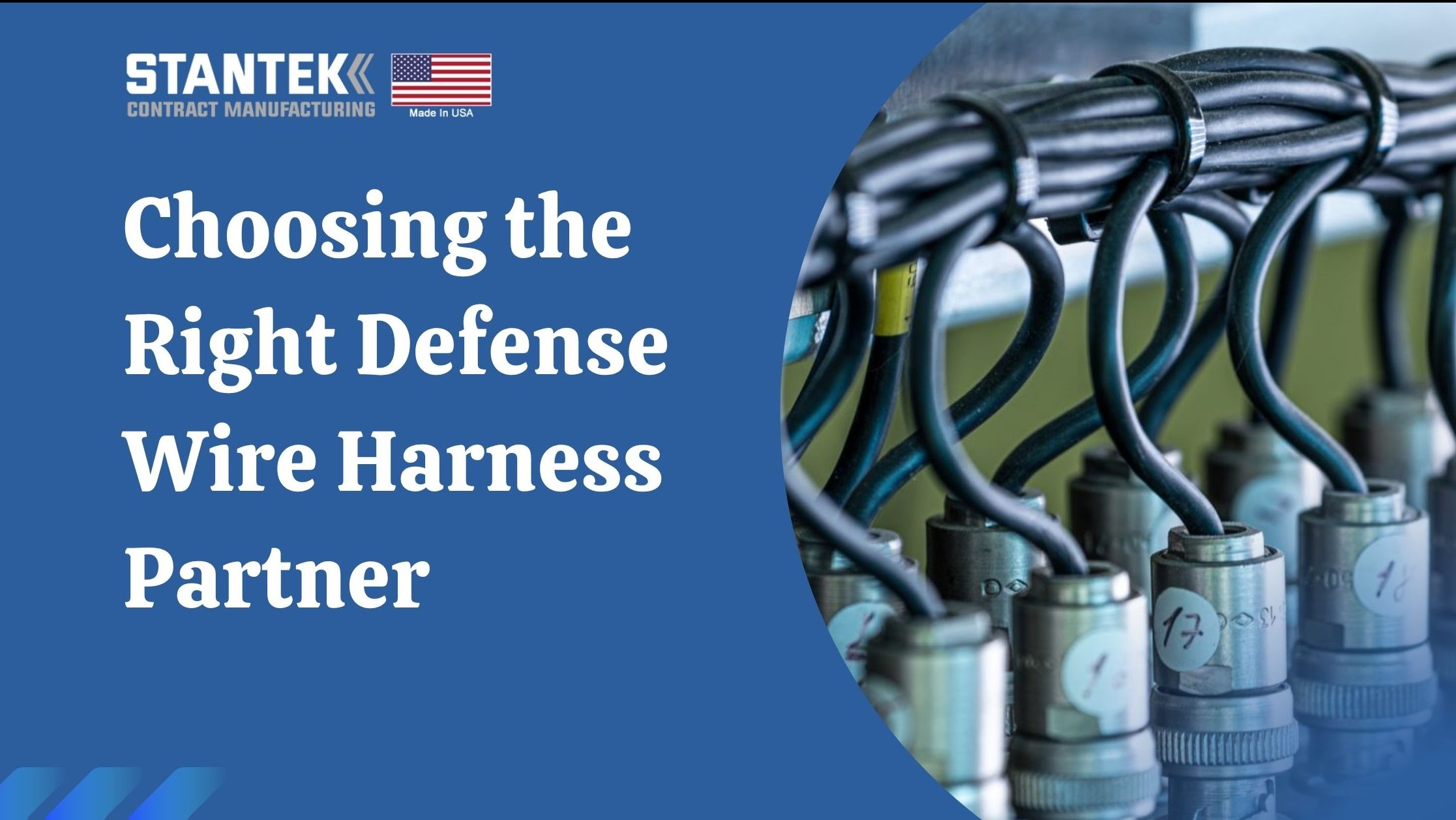
In defense systems, reliability and consistency are critical to system performance. From airborne electronics and ground vehicles to naval systems and communications equipment, a defense wire harness supports power distribution and signal transmission between electrical and electronic components. A failure in an interconnect can affect system functionality, require rework, or contribute to costly production delays.
For OEMs and defense contractors, selecting the right defense manufacturing partner requires more than comparing production costs. Quality controls, applicable standards, material traceability, testing capabilities, documentation, and production capacity are important factors when evaluating a supplier.
A capable defense supplier should be able to manufacture according to customer requirements while maintaining controlled processes and consistent production support. This guide explains the key factors to consider when evaluating a supplier for defense wire harness requirements.
What Is a Defense Wire Harness?
A defense wire harness is a configured group of wires, cables, terminals, connectors, and protective components used to distribute power and transmit electrical signals within defense equipment and systems.
Unlike assemblies used in less demanding environments, defense applications may require specific materials, shielding, connector systems, testing procedures, documentation, and traceability based on the application and customer specifications. Operating conditions can include temperature variation, vibration, moisture, abrasion, chemical exposure, and electromagnetic interference (EMI). These factors make material selection, controlled production, and appropriate testing important considerations when selecting a defense manufacturing supplier.
What Should You Look for in a Defense Wire Harness Supplier?
A reliable defense wire harness supplier should demonstrate controlled quality processes, knowledge of applicable requirements, material and production traceability, appropriate testing capabilities, documentation discipline, and the ability to support the required production volume.
The following areas can help OEMs and defense contractors evaluate potential suppliers.
1. Compliance With Military and Industry Requirements
Standards and customer specifications provide the foundation for consistent defense production. The applicable requirements depend on the specific program, platform, product, and customer.
Important considerations may include:
- IPC/WHMA-A-620: Provides requirements and acceptance criteria for cable and wire harness assemblies.
- MIL-DTL-17: Applies to certain coaxial and multi-conductor cable requirements.
- MIL-W-22759: Covers certain high-performance electrical wire and cable requirements.
- MIL-C-27500: Covers certain electrical cable requirements used in aerospace and military applications.
- Platform-specific requirements: Individual programs may impose additional material, workmanship, documentation, or testing requirements.
- Customer specifications: Contractual requirements may define specific components, processes, inspections, and acceptance criteria.
Not every project requires every standard. A qualified supplier should review the customer’s specifications and determine which requirements apply to the specific program.
Why Are Military Wire Harness Standards Important?
Military and industry standards help establish consistent expectations for materials, workmanship, inspection, testing, and acceptance. When evaluating a supplier, customers should confirm that its quality processes and production procedures align with the requirements applicable to their program.
2. Quality Assurance and Process Control
Quality should be controlled throughout production rather than relying only on final inspection. A dependable defense manufacturing partner should have documented processes for incoming materials, production operations, inspection, testing, and nonconformance management.
Key quality controls may include:
- Incoming inspection of materials and components
- Verification of certificates and customer specifications
- Documented work instructions
- Controlled crimping, termination, soldering, and assembly processes
- In-process inspection at critical production stages
- Final inspection before shipment
- Electrical testing based on customer and application requirements
- Documented nonconformance and corrective-action procedures
- Material and production traceability
Controlled work instructions help ensure that production personnel follow consistent processes across production runs and configuration changes. For defense programs, process discipline is particularly important because production variation can affect electrical performance, mechanical durability, or system integration.
3. Material Selection for Defense Wire Harnesses
Material selection can directly influence the durability and performance of a defense wire harness. The appropriate materials should be determined by the application’s electrical, mechanical, environmental, and customer requirements.
Common material considerations include:
- Conductors: Silver-plated or nickel-plated copper conductors may be specified for applications requiring particular temperature or performance characteristics. The appropriate conductor depends on the applicable wire specification and customer requirements.
- Insulation: Materials such as PTFE, ETFE, and cross-linked materials may be selected according to temperature, flexibility, abrasion, chemical, and environmental requirements.
- EMI shielding: Shielding may be required where electromagnetic interference could affect system performance. Braided, spiral, foil, or combination shielding can be selected based on the application’s requirements.
- Connectors: Military-grade connector families such as MIL-DTL-38999, MIL-DTL-5015, and MIL-DTL-83513 may be used when specified by the application or customer.
- Backshells and sealing: Backshells, boots, and sealing components can provide mechanical protection, strain relief, shielding continuity, or environmental protection depending on the application.
- Protective sleeving: Heat-shrink materials, conduit, and protective sleeving may be used to provide additional protection against abrasion, chemicals, temperature, or mechanical stress.
The important consideration is not simply whether a supplier can source a particular component. The supplier should be able to control material identification, documentation, and use according to the approved customer requirements.
4. Manufacturing Expertise and Technical Support
A strong defense manufacturing partner should combine practical manufacturing expertise with technical support. Before production begins, the supplier should be able to review customer documentation, identify potential production challenges, and provide manufacturing feedback.
Important areas of support include:
- Manufacturability feedback based on customer documentation
- Review of connector, terminal, conductor, and protective material requirements
- Manufacturing considerations for routing and termination
- Identification of potential production or assembly challenges
- Prototype and pilot-build support
- Support when approved customer revisions are introduced
- Communication regarding production and testing requirements
Early manufacturing involvement can help identify potential production issues before recurring builds begin. For prototype programs, this can also help establish controlled production procedures before the project moves into recurring low- or mid-volume production.
5. Traceability, Documentation, and Audit Readiness
Defense programs often require detailed documentation to support quality reviews, audits, maintenance, and long-term program requirements. A capable defense manufacturing supplier should have a structured approach to maintaining production and material records.
Important documentation may include:
- Material identification and lot information
- Certificates of Conformance where required
- Material certifications and supporting documentation
- Controlled bills of materials and revision information
- Inspection records
- Test records
- Production identification where required
- Equipment calibration records
- Nonconformance and corrective-action records
- Production documentation required by the customer or program
Why Is Traceability Important for Defense Wire Harnesses?
Traceability connects production records to the materials, processes, inspections, and tests associated with an assembly. This information can help support quality investigations, audits, failure analysis, and future production requirements. Documentation requirements vary by program. A supplier should therefore establish record-retention and documentation practices according to customer contracts and applicable requirements.
6. Prototype, Low-, and Mid-Volume Production
Defense programs do not always require high-volume production. Prototype builds, qualification units, replacement requirements, specialized equipment, and recurring defense programs can require different production quantities. A suitable defense manufacturing partner should be able to support the production volume and configuration requirements of the program.
Production capabilities to evaluate include:
- Prototype and pilot builds
- Low-volume production
- Mid-volume production
- Multiple part numbers and configurations
- Controlled revision management
- Transition from prototype to recurring production
- First Article Inspection (FAI) when required
- Production scalability as program requirements changes
- Processes for managing changing production requirements
Can a Defense Wire Harness Be Produced in Low Volumes?
Yes. Defense programs can require relatively small production quantities, particularly during prototype, qualification, specialized equipment, or replacement phases. When evaluating a supplier, customers should confirm production capacity, minimum order requirements, lead times, configuration management, testing capabilities, and quality controls for the required production volume. The ability to support low- and mid-volume production can be particularly valuable for OEMs and defense contractors managing specialized or evolving programs.
7. Defense Wire Harness Testing and Validation
Testing provides an important verification step before a defense wire harness is integrated into a larger system. The required tests should be determined by the customer’s specifications, applicable standards, and application requirements.
Testing may include:
- Continuity Testing: Verifies circuit integrity and helps identify open circuits, shorts, and incorrect connections.
- Insulation Resistance Testing: Evaluates insulation performance between conductors or between conductors and ground.
- High-Potential (Hi-Pot) Testing: Applies an elevated voltage to evaluate insulation integrity under specified conditions.
- Functional Testing: Where applicable, verifies that an assembly performs correctly within the intended interface or simulated system environment.
- Thermal Testing: Where specified, evaluates performance under defined temperature conditions.
- Vibration Testing: Where required, evaluates assembly integrity and connector retention under defined mechanical conditions.
- Test Equipment Calibration: Test equipment should be maintained according to defined calibration requirements, with appropriate records retained for traceability.
Not every assembly requires every test. The applicable testing program should be established from the customer’s specifications and applicable requirements
Common Risks in Supplier Selection
These are the most frequent failure modes in defense wire harness procurement and the program consequences they generate.
| Risk | Program Consequence |
| Selecting on price over capability | Higher total cost through rework, field failures, and program delays |
| Partial standards compliance | Audit failures, non-conforming deliveries, disqualification risk |
| Inadequate documentation | Inability to support failure investigations or configuration audits |
| No engineering involvement | Design defects reaching hardware; missed DFM opportunities |
| Inconsistent quality across batches | Unpredictable field reliability; repeated corrective action cycles |
| Inability to support long-term programs | Supplier transitions that break documentation continuity and institutional knowledge |
| Single-source material dependency | Supply chain vulnerability when qualified materials are constrained or discontinued |
How to Evaluate a Defense Wire Harness Supplier
Before selecting a supplier, OEMs and defense contractors should consider the following:
- Does the supplier have experience with defense applications?
- Can it meet the applicable customer and program requirements?
- Does it maintain documented quality processes?
- Are materials and production records traceable?
- What testing capabilities are available?
- Can it support prototype, low-volume, and mid-volume production?
- Can it manage multiple configurations and revisions?
- Can it provide required documentation?
- Does it have processes for handling nonconformances and corrective actions?
- Can it maintain consistent quality and delivery performance?
A supplier evaluation should consider the complete manufacturing process rather than focusing only on unit price.
Choosing the Right Defense Manufacturing Partner
Selecting a defense manufacturing partner is a long-term decision that can affect quality, production continuity, documentation, and program support. The right supplier should be able to work from customer requirements while maintaining controlled processes, appropriate testing, traceability, and production consistency.
Stantek Contract Manufacturing provides wire harness and cable assembly manufacturing for prototype, low-volume, and mid-volume OEM requirements. Its capabilities support applications across defence and other industries, including aerospace, automotive, medical, marine, and industrial equipment. Stantek provides manufacturing feedback, production support, and testing based on customer requirements. This approach can help identify manufacturability considerations, production requirements, and applicable testing needs before production begins. If you are evaluating a defense wire harness supplier for an upcoming program, contact Stantek to discuss your manufacturing requirements.