



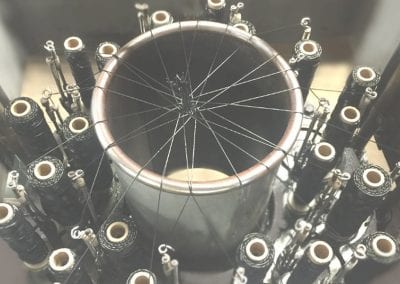
Machine-applied wire braiding is a manufacturing technique used to incorporate an interwoven covering into wire, cable, and wire harness assemblies. The construction involves arranging multiple strands in a specific pattern, with the resulting structure influenced by material selection, braid angle, and coverage density. These parameters are determined by the physical characteristics and functional requirements of the finished assembly.
What Is Machine-Applied Wire Braiding?
Machine-applied wire braiding is a manufacturing process that uses specialized equipment to interweave strands into a flexible protective sleeve around wires, cables, or wire harnesses. Common materials include polyester, nylon, aramid fibers, and conductive metallic strands, selected according to the application’s requirements. The resulting braid serves as an outer covering, distinct from the conductor strands inside a wire that carry electrical current. Machine-applied braiding describes the manufacturing method, while the braid’s material and construction determine its protective function.
How the Machine-Applied Wire Braiding Process Works
Machine-applied wire braiding involves several controlled manufacturing steps to produce a protective covering that meets the cable assembly’s specifications.
- Application Requirements: The process begins by identifying the cable or wire bundle dimensions, required braid coverage, material specifications, flexibility requirements, and operating conditions. These parameters guide the machine setup and braiding configuration.
- Material Preparation: The selected yarns, fibers, or metallic strands are loaded onto the machine’s carriers. Material selection depends on the required properties and the intended application.
- Braid Formation: During braiding, carriers move around the cable or bundle, interlacing strands in opposing directions to form a tubular, braided structure. The strands combine to create a flexible outer covering.
- Cable Feeding and Coverage Control: The cable or bundle passes through the braiding zone as the machine applies the braid. Carrier movement, braiding speed, and substrate feed rate influence the braid angle, density, and coverage.
- Cutting and Finishing: Once the required length is braided, the section is cut and finished according to the assembly specifications. Additional securing or termination may be required to prevent the braid from unravelling or shifting.
- Inspection and Verification: The finished braid is inspected for coverage, consistency, dimensions, and visible defects. Measurements and checks are performed against the applicable specifications to verify that the assembly meets its quality requirements.
Equipment Used in Machine-Applied Wire Braiding
Machine-applied wire braiding relies on several equipment components working together to produce a consistent protective covering around wires, cables, wire harnesses.
- Braiding Machine: The main equipment interlaces strands around the cable or bundle to form the braided structure.
- Carriers and Bobbins: Bobbins hold the braiding material, while carriers guide the strands along designated paths to create the required interwoven pattern.
- Material Tension and Feed Systems: These systems regulate strand delivery and help maintain consistent tension during braiding, supporting uniform construction.
- Guides and Sizing Components: Guides position the cable or bundle as it passes through the braiding zone. Sizing components, where used, help maintain the required dimensions and alignment.
- Take-Up and Cutting Equipment: Take-up systems manage material movement where applicable, while cutting equipment prepares braided sections to the specified length.
- Inspection Equipment: Measuring tools and visual inspection methods help verify braid coverage, dimensions, consistency, and workmanship.
Equipment configuration varies according to the braiding material, cable dimensions, required coverage, product specifications, and production volume. Selecting suitable equipment helps manufacturers meet application-specific requirements and maintain consistent product quality.
Key Benefits of Machine-Applied Wire Braiding
Machine-applied wire braiding offers several practical benefits for cable protection and wire harness manufacturing. The level of protection depends on the braid material, construction, and application requirements.
- Mechanical Protection: The braided outer layer helps protect cable jackets and insulation from rubbing, contact, and routine mechanical wear during installation and operation.
- Abrasion Resistance: Braiding can reduce surface wear when cables contact surrounding components or other surfaces, helping maintain the integrity of the underlying cable jacket.
- Flexibility and Routing: Depending on the material and braid construction, the covering can accommodate bends and complex routing paths without unnecessarily restricting cable movement.
- Consistent Coverage: Properly configured and monitored machine braiding supports repeatable braid patterns and coverage, helping manufacturers maintain consistent product quality across production runs.
- Cable Bundling and Organization: Braided sleeves can enclose multiple wires or cables within a unified covering, supporting organized routing and easier handling during assembly.
- EMI/RFI Shielding: When conductive materials are used with suitable coverage, electrical bonding, and termination, braiding can help reduce electromagnetic and radio-frequency interference. However, this capability is not provided by every braided covering.
- Application-Specific Configurations: Materials, braid dimensions, coverage, and construction can be selected to suit different cable sizes, routing conditions, and performance requirements.
Overall, machine-applied wire braiding provides a versatile approach to cable protection, with performance determined by the selected materials, braid construction, and application requirements.
Industrial Applications of Machine-Applied Wire Braiding
Machine-applied wire braiding is used across industries where wires, cables, and harnesses require additional protection, organized routing, or application-specific shielding.
- Automotive and Electric Vehicles: Braided coverings can protect wire harnesses routed near moving components or areas subject to vibration and mechanical wear.
- Industrial Machinery and Automation: Cable assemblies used around actuators, moving equipment, and machinery components can benefit from braided protection against abrasion and contact with surrounding surfaces.
- Electrical and Electronic Equipment: Braiding helps organize internal wiring and provides an additional protective layer where cables may encounter friction during installation, assembly, or operation.
- Robotics and Motion-Control Systems: Braided coverings can help protect cable assemblies exposed to repeated movement and bending, provided the braid construction and materials meet the application’s flex-life requirements.
- Specialized Electrical and Instrumentation Systems: Conductive braiding may be used where electromagnetic interference (EMI) or radio-frequency interference (RFI) shielding is required. Its effectiveness depends on shielding coverage, electrical continuity, bonding, and termination.
How Stantek Supports Machine-Braided Wire Harness Manufacturing
Stantek Manufacturing, LLC provides low-to-mid-volume contract manufacturing for wire harnesses and cable assemblies. Where available and required by the application, braided coverings can be incorporated into an assembly according to customer specifications, including material selection, braid dimensions, and coverage requirements. This approach helps ensure that the protective covering meets the assembly’s intended application needs.
For projects requiring braided wire protection, the appropriate manufacturing approach depends on the assembly specifications and application requirements. Looking for a custom wire harness or cable assembly with braided protection? Contact Stantek Manufacturing, LLC to discuss your project requirements and production needs.