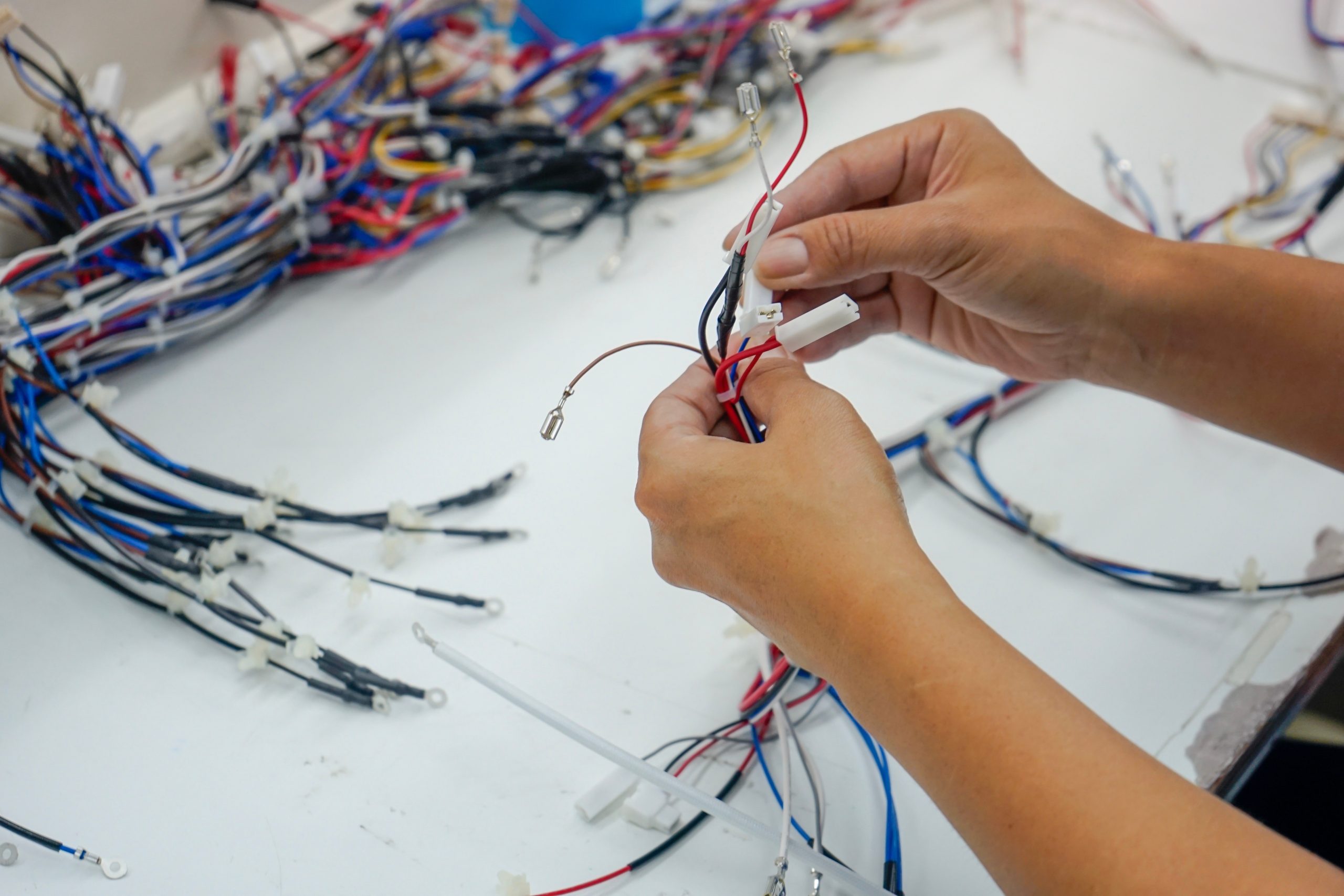
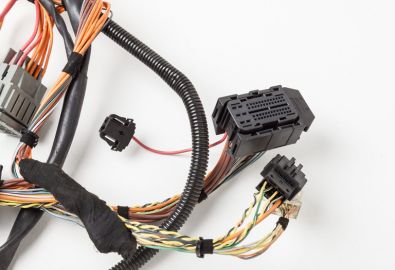
Ribbon cable assembly manufacturing depends on conductor arrangement, connector compatibility, termination requirements, and the intended installation environment. Stantek manufactures assemblies to customer-provided drawings and specifications, with inspection and electrical testing based on defined requirements.
What Are Ribbon Cable Assemblies?
Ribbon cable assemblies use multiple parallel conductors arranged in a flat, evenly spaced configuration to provide organized electrical connections between components. This flat construction allows multiple circuits to be routed together efficiently, particularly where installation space is limited.A typical assembly combines ribbon cable with compatible connectors or termination hardware selected according to conductor count, pitch, interface, and installation requirements. Insulation displacement connectors (IDC) are commonly used with compatible ribbon cables because they allow multiple conductors to be terminated through a single connector operation. Depending on the application, configurations may include standard or shielded ribbon cable assemblies.The appropriate cable construction and termination method depend on electrical requirements, connector compatibility, mechanical conditions, and the equipment's intended use.
Trusted Partner for Ribbon Cable Assembly Manufacturing
Stantek brings practical manufacturing experience to ribbon cable assemblies where repeatable assembly and dependable electrical interconnections are essential. Production requires attention to cable alignment, connector positioning, termination quality, and dimensional consistency across finished assemblies.Stantek supports customers with production coordination and manufacturing processes designed to accommodate new product introductions and ongoing supply requirements. Customer drawings, specifications, and approved assembly configurations provide the basis for manufacturing, helping maintain consistency when prototype builds progress to repeat orders.With flexible production capabilities, Stantek supports prototype, development, and low-to-mid volume programs. Each assembly is produced with controlled processes, inspection, and testing appropriate to the specified requirements. Our Ribbon Cable Assembly Manufacturing Capabilities
Stantek provides ribbon cable assembly manufacturing for application-specific electrical interconnections. Key capabilities include:- Custom Ribbon Cable Configurations: Multi-conductor flat cable assemblies configured for organized, space-efficient electrical connections.
- IDC Ribbon Cable Assemblies: Compatible cable and IDC connector combinations for multi-contact electrical connections.
- Shielded Ribbon Cable Assemblies: Shielded configurations for applications requiring additional protection against electromagnetic interference, according to specified requirements.
- Custom Dimensions and Pitch: Cable lengths, conductor counts, pitches, and connector arrangements based on customer specifications.
- Electronic Interconnections: Assemblies for board-to-board, board-to-device, and internal equipment connections where ribbon cable interfaces are specified.
- Termination Options: IDC, crimped, and other applicable termination methods selected according to cable and connector requirements.
- Mechanical Protection: Strain relief and protective features where required for handling, installation, and durability.
- Prototype and Low-to-Mid Volume Production: Flexible manufacturing support for new and established product programs.
- Inspection and Electrical Testing: Checks for connector placement, cable orientation, dimensions, workmanship, continuity, and other applicable electrical requirements.
- Documentation and Traceability: Production records, revision control, and applicable material traceability.
Why Choose Stantek for Ribbon Cable Assembly Manufacturing?
- Quality Assurance: Stantek operates under a Quality Management System certified to ISO 9001:2015 by Smithers Quality Assessments. Applicable IPC/WHMA-A-620 CIT and J-STD-001 CIT requirements support workmanship, process control, and quality verification.
- Just-in-Time Delivery: Lean manufacturing practices and Kanban-based material planning, where applicable, help coordinate material availability and production schedules. This supports planned deliveries for recurring ribbon cable assembly requirements.
- Prototype Support and Manufacturability Feedback: Initial builds can reveal practical considerations involving cable alignment, connector access, termination, fit, and assembly. Stantek provides manufacturing feedback to help customers refine configurations for subsequent production.
- U.S.-Based Contract Manufacturing: Stantek manufactures ribbon cable assemblies at its facility in Stanton, Kentucky, providing a domestic production source for customers seeking U.S.-based contract manufacturing support.
Industries We Serve
Stantek supports ribbon cable assembly requirements for electronic equipment and industrial systems where the specified cable, connectors, and manufacturing requirements align with its capabilities.
- Industrial Equipment and Automation: Ribbon cable assemblies can connect control boards, operator interfaces, instrumentation, and internal electronic modules in industrial equipment. Cable pitch, connector orientation, routing, and termination must match the equipment specifications.
- Computers and Electronic Equipment: Flat ribbon cable assemblies can provide organized internal connections between circuit boards, modules, storage components, and peripheral interfaces. The assembly configuration depends on conductor count, connector compatibility, signal requirements, and available installation space.
- Telecommunications and Networking: Ribbon cable assemblies may be used for internal signal and control connections within communication and networking equipment. Specified connector interfaces, shielding requirements, and electrical testing help determine the appropriate configuration.
- Test and Measurement: Electronic test equipment and measurement systems may use ribbon cable assemblies to connect internal boards, control modules, and measurement components. The cable and termination configuration should support the required electrical connections and equipment layout.
How Stantek Manufactures Ribbon Cable Assembly
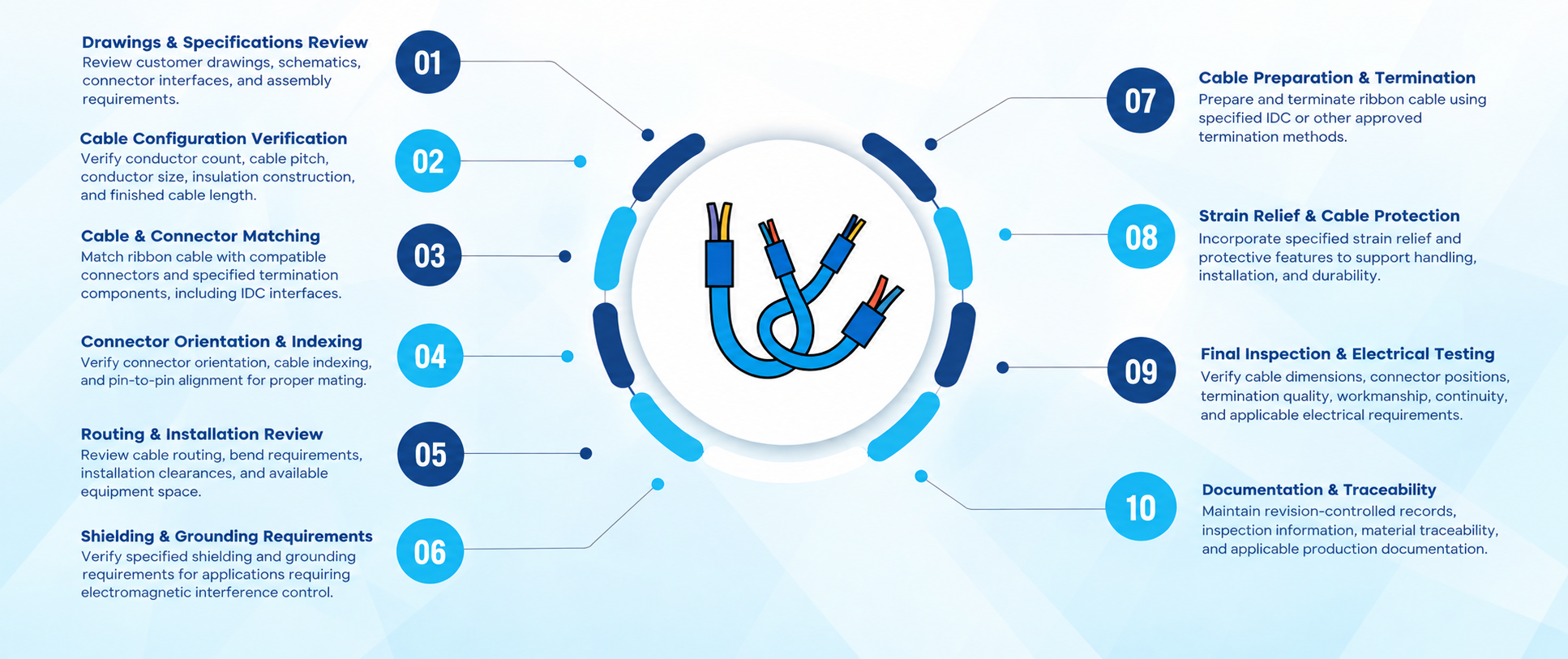
Stantek manufactures ribbon cable assemblies according to customer drawings, specifications, and defined production requirements. The process focuses on cable and connector compatibility, accurate termination, assembly inspection, and verification of specified electrical connections.
- Drawings and Specifications Review: Review customer drawings, schematics, bills of materials, conductor requirements, connector details, dimensions, and applicable production criteria to establish the required assembly configuration.
- Cable Conductor Count and Pitch Verification: Verify the specified conductor count, conductor spacing, cable pitch, cable width, and finished length against the customer documentation. These dimensions must match the intended connector and installation requirements.
- Cable and Connector Compatibility: Confirm that the specified ribbon cable is compatible with the selected connector, including conductor count, pitch, contact arrangement, and applicable electrical requirements.
- Connector Orientation and Alignment: Verify connector orientation, indexing, contact alignment, and connection layout according to the assembly drawings. Correct alignment supports proper mating and consistent assembly configuration.
- Cable Preparation and Cutting: Prepare the ribbon cable to the specified length and configuration using suitable cutting and handling methods. Cable preparation must maintain the required dimensions and avoid damaging conductors or insulation.
- Connector Termination: Apply the specified termination method, including IDC termination where compatible with the selected cable and connector. Termination procedures follow applicable workmanship requirements and component specifications.
- Strain Relief and Mechanical Protection: Incorporate specified strain relief, protective components, or other mechanical features where required. These features help protect the assembly during handling, installation, and operation.
- Assembly Inspection: Inspect cable length, connector position, orientation, alignment, dimensions, and visible workmanship against the applicable acceptance criteria.
- Continuity and Electrical Testing: Perform continuity verification and other specified electrical checks to confirm required connections. Testing is based on customer specifications and applicable assembly requirements.
- Documentation and Traceability: Maintain applicable inspection records, material information, drawing revisions, and production documentation. These records support configuration control and consistency across repeat orders.
Applications of Ribbon Cable Assemblies
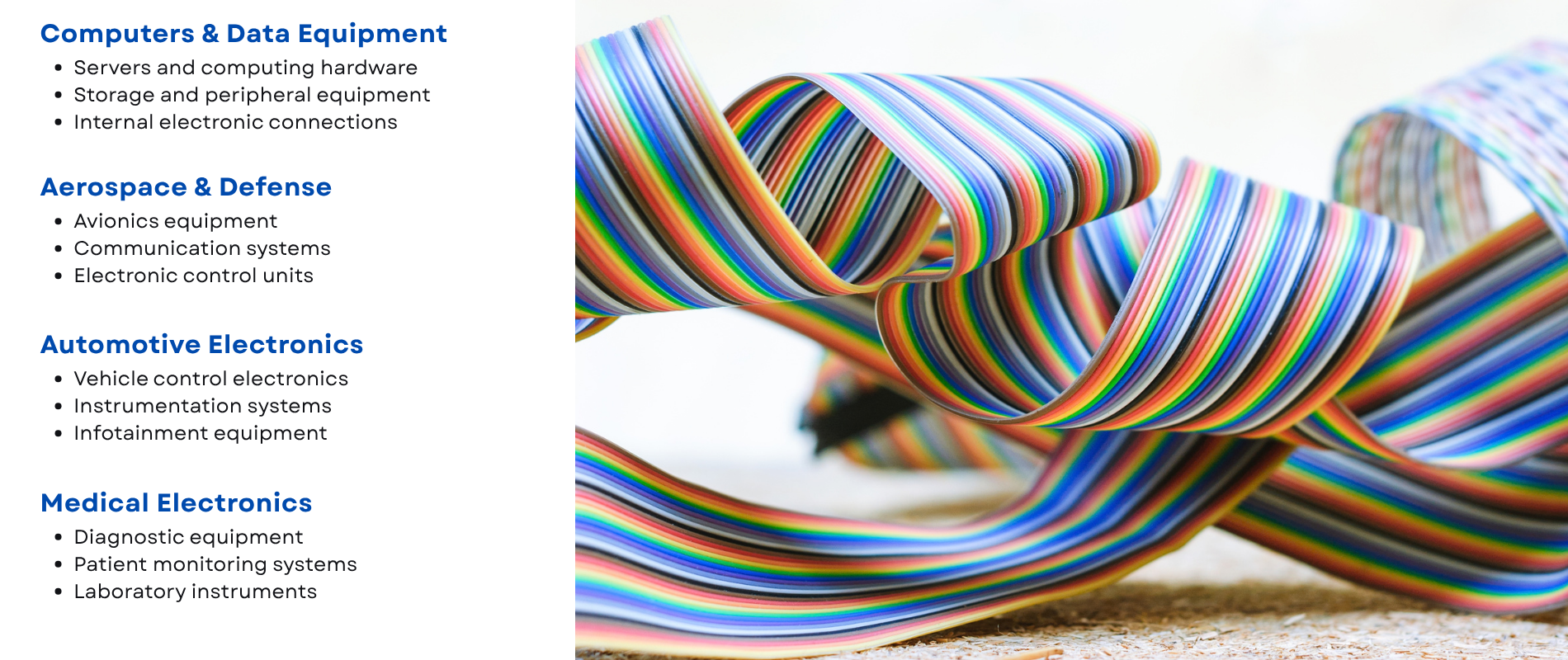
Ribbon cable assemblies provide organized electrical connections in electronic equipment where multiple conductors, compatible interfaces, and compact internal wiring are required.
- Computers and Data Equipment: Ribbon cable assemblies support internal connections in servers, computing hardware, storage and peripheral equipment. They connect circuit boards and electronic components where compact, organized multi-conductor wiring is required.
- Aerospace and Defense Electronics: Specified electronic systems may use ribbon cable assemblies for internal connections in communication equipment, control units, and other electronic subsystems. Assembly configurations must meet applicable customer specifications and program requirements.
- Automotive Electronics: Ribbon cable assemblies can provide internal connections in vehicle control electronics, instrumentation systems, and infotainment equipment designed for ribbon cable interfaces. Connector compatibility, cable dimensions, and installation conditions determine the appropriate configuration.
- Medical Electronics: Diagnostic equipment, patient monitoring systems, and laboratory instruments may use ribbon cable assemblies to connect circuit boards and electronic control modules. Assemblies are manufactured according to specified electrical, dimensional, and application requirements.
Bring Your Ribbon Cable Assembly Requirements to Production
Stantek manufactures
custom cable assemblies for electronic and electrical applications requiring defined conductor arrangements, compatible connectors, and controlled assembly processes. Prototype and low-to-mid volume production capabilities support application-specific requirements from initial builds through repeat orders.Share your drawings, cable specifications, conductor count, pitch, connector details, target quantities, and testing requirements to discuss your ribbon cable assembly project and
contact us.