



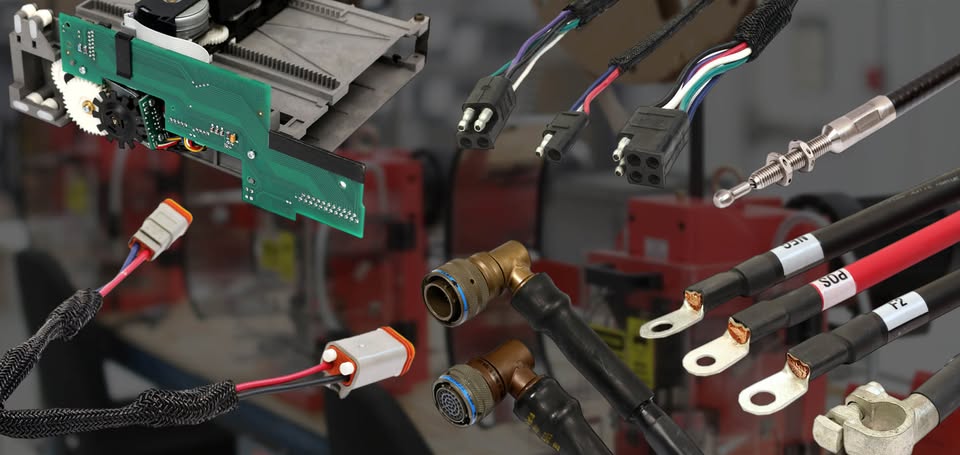
What are Wire Harness Types?
Wire harness can be categorized by their function, construction, application, and operating environment. Common Wire harness types include main wiring harnesses, secondary wiring harnesses, braided wire harnesses, industrial wiring harnesses, heavy equipment wiring harnesses, and robot wire harnesses. The appropriate Wire harness type depends on electrical requirements, mechanical stresses, environmental conditions, installation space, and application requirements.
Categories of Wiring Harnesses
Wire harnesses can be categorized based on their role within an electrical system, their construction features, or the application they are designed to support. In many cases, a single assembly may incorporate characteristics from multiple categories. For example, a robot wire harness may function as a secondary harness while also incorporating braided protection to improve resistance to abrasion and repetitive movement. Here are the key categories to know.
- Main Wiring Harnesses: Main wiring harnesses serve as the primary electrical backbone of a system, distributing power and routing signals between major subsystems such as controllers, sensors, actuators, communication modules, and operator interfaces. They support centralized electrical architecture, reduce wiring complexity, simplify installation, and improve serviceability throughout the equipment lifecycle.
- Key Characteristics
- Multi-circuit configurations
- Centralized routing architecture
- Organized routing and cable management
- Multiple connectors, terminals, and breakout points
- Key Characteristics
- Secondary Wiring Harnesses: Secondary wiring harnesses, or sub-harnesses, connect localized devices and subsystem assemblies to the primary electrical network. Commonly used in modular equipment designs, they support sensors, control panels, and auxiliary devices while simplifying installation, maintenance, troubleshooting, and future system modifications.
- Key Characteristics
- Lower circuit density
- Shorter routing lengths
- Defined branch pointsApplication-specific connectors
- Dedicated power or signal paths
- Key Characteristics
- Braided Wire Harnesses: Braided wire harnesses incorporate protective braided sleeving around grouped conductors to provide additional mechanical protection and cable management. The braided covering helps reduce wear caused by abrasion, vibration, and repeated movement while maintaining organized wire routing. These assemblies are often selected for applications where wiring is exposed to harsh operating conditions or confined installation spaces.
- Key Characteristics
- Lightweight mechanical protection
- Tool-free breakout flexibility
- Fray-resistant terminated endsImproved bundle organization
- Compatibility with standard cable ties, clamps, and P-clips for mounting
- Key Characteristics
- Industrial Wiring Harnesses: Industrial wiring harnesses are used in manufacturing equipment, automation systems, and industrial control environments. These assemblies support communication and power distribution between controllers, sensors, actuators, drives, motors, and operator interfaces. As industrial systems frequently operate continuously, these harnesses are designed to withstand electrical noise, vibration, contaminants, and repeated operating cycles.
- Key Characteristics
- EMI/RFI shielding options
- Industrial communication compatibility
- Ruggedized connector interfaces
- Control and power circuit integration
- Key Characteristics
- Heavy Equipment Wiring Harnesses: Heavy equipment wiring harnesses are designed for machinery operating in physically demanding environments. These assemblies support electrical systems exposed to dust, moisture, shock loading, vibration, and temperature fluctuations. These assemblies typically incorporate sealed connectors, protective sleeving or conduit, secure wire retention, and strain relief to protect conductors and connection points from environmental and mechanical stresses.
- Key Characteristics
- High-current power distribution circuits
- Reinforced retention and clamping points
- Key Characteristics
- Robot Wire Harnesses: Robot wire harnesses are developed for applications involving continuous movement and repetitive motion. Unlike conventional wiring assemblies, these harnesses must tolerate repeated flexing, bending, and torsional loads without compromising electrical performance. High-flex conductors, appropriate bend-radius control, abrasion-resistant materials, and effective strain relief help minimize mechanical stress and extend harness flex life in dynamic robotic applications.
- Key Characteristics
- Compatibility with cable carriers and drag chains for guided motion paths
- Compact bundle diameter to fit within tight robotic joint spaces
- Low-friction outer jacketing
- Connector locking features
- Key Characteristics
How Different Industries Select the Right Wiring Harness Type
The wiring harness types discussed above are widely used across different applications, and no single harness type is exclusive to a particular industry. Main, secondary, braided, industrial, heavy equipment, and robotic wire harnesses can all be adapted to support different applications depending on system requirements. The selection process is typically driven by operating conditions, electrical performance needs, mechanical stresses, installation constraints, and regulatory requirements.
- Automotive and Transportation Equipment: Manufacturers prioritize harnesses that can withstand vibration, temperature fluctuations, and confined installation spaces while supporting power distribution, control systems, sensors, lighting, and communication networks.
- Industrial Automation and Robotics: OEMs and system designers often select harnesses according to application requirements such as continuous-duty operation, repetitive motion, equipment modularity, and resistance to electrical noise, vibration, and contaminants. These harnesses are commonly used in automated production lines, robotic cells, material handling equipment, control panels, sensors, and actuators.
- Aerospace Systems: Aerospace OEMs and system designers select wire harnesses to meet demanding requirements for weight reduction, reliability, signal integrity, and environmental resistance for use in navigation systems, avionics, and communication equipment.
- Medical Devices: Medical equipment applications often require harnesses that support compact designs, reliable signal transmission, and consistent performance. These harnesses are used in diagnostic, monitoring, imaging, and laboratory equipment.
- Defense Equipment: DefenceHarnesses here are selected to maintain electrical integrity in environments exposed to vibration, moisture, dust, shock, and temperature extremes. These harnesses are used in communication systems, tactical vehicles, surveillance equipment, and mission-critical electronics.
- Heavy Equipment and Off-Highway Machinery: Manufacturers select wire harnesses designed to withstand harsh operating conditions, including mechanical stress, environmental exposure, and prolonged service demands for use inconstruction, agriculture, mining, and material handling equipment.
Key Design Considerations for OEM Wire Harness Projects
Developing a reliable wire harness requires careful evaluation of electrical, mechanical, environmental, and manufacturing requirements from the early design stages. Here are the key considerations OEMs should evaluate when planning a wire harness project:
- Address Environmental Conditions: Consider exposure to heat, moisture, dust, chemicals, and UV radiation when selecting appropriate insulation, protective coverings, sealing methods, and connector systems.
- Optimize Electrical Performance: Meet voltage, current, signal integrity, and EMI requirements through proper conductor sizing, insulation selection, circuit routing, shielding, and grounding strategies.
- Manage Mechanical and Installation Requirements: Account for vibration, flexing, abrasion, strain, and available routing space when determining harness layout, strain relief, support methods, and protective coverings.
- Manufacturing Considerations: Consider assembly methods, component standardization, production volumes, testing requirements, and process efficiency during harness design to support consistent and repeatable manufacturing.
How Custom Wire Harness Solutions Improve Reliability and Manufacturability
Custom wire harness solutions allow OEMs and system designers to optimize circuit routing, connector placement, conductor selection, and protective features for the intended application. Here are some key advantages of using a custom wire harness solution:
- Simplify System Integration: Custom wire harnesses are configured to fit within the equipment architecture, improving routing efficiency, reducing excess wiring, and creating a more organized electrical system.
- Reduce Installation and Wiring Errors: Preconfigured assemblies minimize individual wiring connections, shorten installation time, reduce errors, and improve consistency across production runs.
- Increase Reliability: Application-specific harnesses are manufactured to meet environmental, electrical, and mechanical requirements. Proper conductor sizing, connectors, shielding, strain relief, and protective coverings help maintain performance under vibration, temperature fluctuations, moisture, and repetitive movement.
- Improve Serviceability: Organized routing and clearly defined connection points simplify troubleshooting, maintenance, and component replacement, helping reduce downtime and support efficient equipment servicing throughout its lifecycle.
Build Reliable Wire Harness Solutions with Stantek
Turn your wire harness requirements into a production-ready solution with Stantek Manufacturing. Our team works with OEMs to manufacture custom assemblies that align with application specifications, production requirements, and quality expectations. Explore our wire harness solutions or contact our team to discuss your project requirements.